
AI legal research is transforming how lawyers and law firms in India approach their work. Gone are the days when legal research meant hours of manual text searches through endless judgments and acts. Today, AI legal research tools can analyze vast legal databases in seconds, helping lawyers focus on strategy instead of paperwork.
In this article, we explore the top 5 AI legal research tools in India that are chaning how legal professionals work and make decisions. With the rise of advanced artificial intelligence tools, legal research has become faster, smarter, and far more affordable than ever before. Across the Indian legal industry Especially among younger lawyers, there’s a growing shift towards AI-powered solutions that simplify case law analysis, drafting, and document review.
1. NyaySaathi – The All-in-One AI Legal Research and Drafting Platform
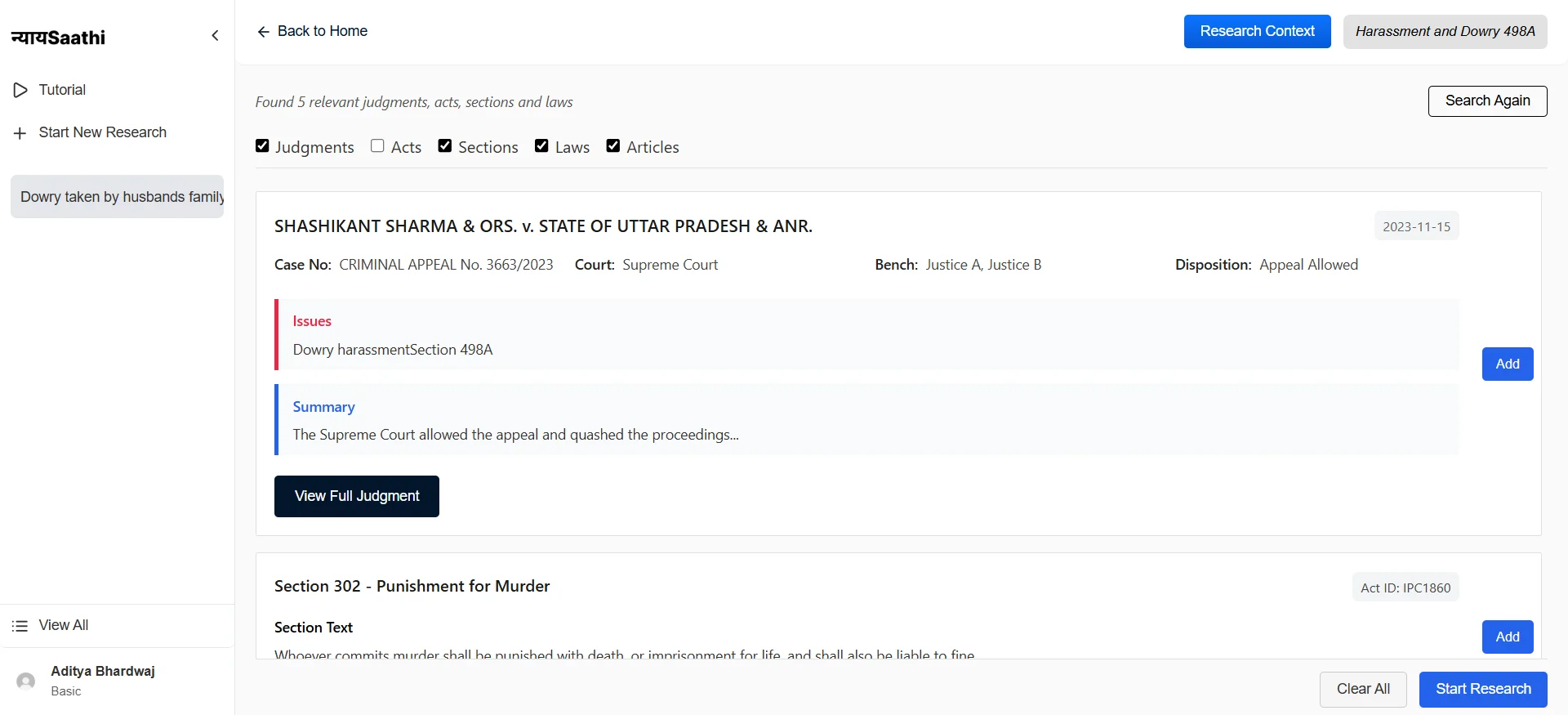
The first tool on our list is NyaySaathi. NyaySaathi is an Indian Legal Tech platform that offers not just AI legal research tools but also AI-powered legal drafting and automated draft analysis.
NyaySaathi has an extensive database of over 10 million Supreme Court and High Court judgments combined. It uses advanced RAG (Retrieval-Augmented Generation) techniques to provide intelligent search functionality — where users simply need to describe their case, and the AI finds all the relevant information, including judgments, statutes, bare acts, laws, notifications, ordinances, and articles.
Once you’ve selected the documents relevant to your case, NyaySaathi builds a context for them. Based on this context, you can then ask multiple case-specific questions directly to the AI, making legal research faster, deeper, and far more efficient.
Pros
- Built on completely new technology — search results are highly accurate and case-specific.
- Empowers users with AI to analyze and understand lengthy judgments, their connections to your case, and the impact of various statutes involved.
- Significantly more affordable compared to other AI legal research tools in India.
- Offers a 3-day free trial, allowing users to test the platform and decide if it fits their needs.
Cons
- Still a relatively young company with a comparatively smaller database — though it’s growing rapidly and has immense future potential.
2. SCC Online – A Trusted Name in Traditional Legal Research

SCC Online is one of the oldest and most trusted pillars of legal research in India. It offers powerful keyword and Boolean search features with extensive filters. The platform is even used by the Supreme Court of India in citations, reflecting its credibility and authority in the legal field.
However, when it comes to AI-based legal research, SCC Online still relies largely on traditional search methods. That said, it provides other valuable features such as Digest Notes and Case Law Search, which help in deep legal study and citation tracing.
Interestingly, SCC Online can serve as an excellent companion to NyaySaathi. Since NyaySaathi currently has a comparatively smaller database, users can manually import judgments from SCC Online and leverage NyaySaathi’s AI-based analysis for deeper insights.
Pros
- Extremely large and authoritative database containing judgments, journals, tribunals, statutes, and more
- Trusted across the legal community — even the Supreme Court frequently cites SCC Online.
Cons
- Does not yet offer true AI-based search or analysis capabilities; however, it can complement tools like NyaySaathi for that purpose.
- Very expensive — almost three times the price of NyaySaathi.
3. Manupatra – A Veteran Legal Research Platform with Partial AI Integration

Manupatra is another one of India’s oldest and most comprehensive legal research tools, quite similar to SCC Online in its structure and database depth. Like SCC, Manupatra still doesn’t offer a fully AI-based legal research experience, but it does include a few smart features that slightly bridge the gap.
One of Manupatra’s notable features is its synonym-matching option, which helps improve search accuracy compared to standard keyword searches — though it still can’t be compared to AI RAG-based search systems like NyaySaathi. Additionally, Manupatra provides AI-generated summaries of judgments highlighting key facts, and tools for comparing similar judgments, along with behavioral analytics for judges and lawyers.
Pros
- Vast and reliable database, though not as frequently cited in judgments as SCC Online, making it slightly less authoritative.
- Offers legal analytics tools such as Case Maps, Authority Check, and Judge Analytics — useful for in-depth case strategy.
- Supports multiple devices, including mobile apps and desktop versions, enhancing accessibility and convenience.
Cons
- AI adoption is still incomplete, and the search system doesn’t fully leverage modern AI technologies.
- Pricing is again on the higher side — almost similar to SCC Online, making it quite expensive compared to NyaySaathi.
LegitQuest – AI-Powered Legal Search

LegitQuest offers an AI-powered legal research tool called iSearch, which intelligently structures judgments into distinct sections — such as facts, arguments of petitioner advocates, arguments of respondent advocates, issues, precedents, and reasoning. This makes it easier for users to understand complex judgments at a glance.
The platform also provides auto-generated digest notes that summarize key rulings and case essentials. However, compared to NyaySaathi, LegitQuest lacks advanced AI analysis capabilities and does not allow users to continuously ask contextual questions about the judgments they find.
Pros
- Offers AI-based search functionality through its iSearch feature.
- Similar to NyaySaathi, it also provides AI-assisted drafting and real-time updates, which are useful for active legal professionals.
Cons
- Extremely expensive — the Personal Plan costs around ₹40,000 for six months, while Enterprise Plans can go up to ₹3,00,000.
- Poor price-to-functionality ratio compared to competitors like NyaySaathi.
5. BharatLaw AI – India-Focused AI Legal Research Platform

Since the Indian market for AI legal research is still emerging, one of the promising newer entrants is BharatLaw (or BharatLaw.ai). The platform advertises “advanced AI technology” that can create precise summaries of judgments, compress complex legal texts into one-page formats, and thereby support efficient research.
Pros
- Focused specifically on Indian law, so its models and database are likely tailored for Indian judgments, statutes, and legal context.
- Emphasis on concise summarization can reduce cognitive load when navigating long judgments.
Cons
- Being newer/less established, its database size, pricing model, and AI depth may still lag behind incumbents.
- It may not yet have full drafting or deep question-answering features like NyaySaathi.